

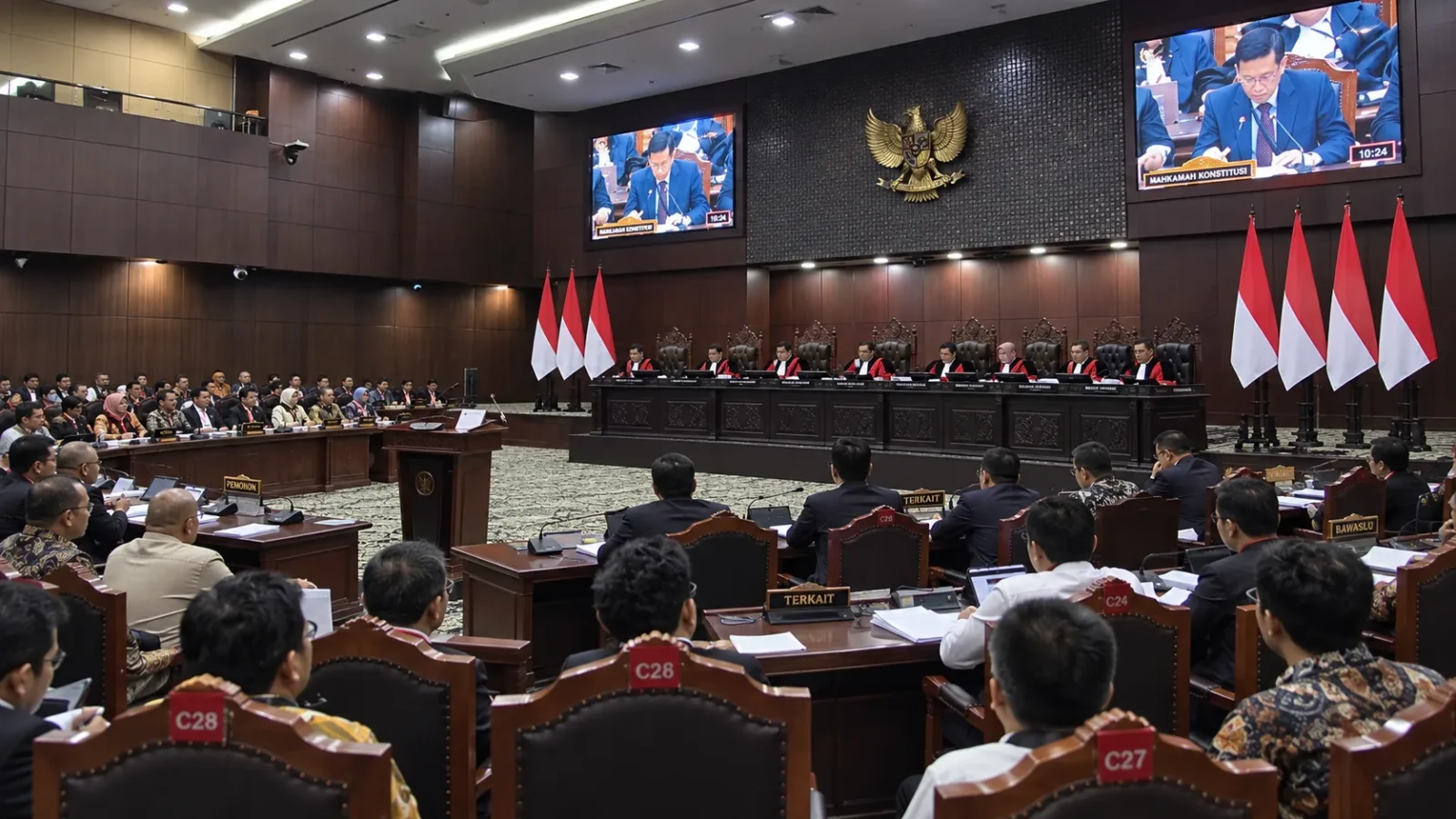
Jakarta Law Firm – Following the public uproar over the controversy surrounding Jokowi’s diploma, an issue regarding Gibran’s diploma has now emerged and is being heard by the Constitutional Court. The debate is particularly compelling due to two key issues: the statute of limitations regarding the constitutionality of the petition, and the Constitutional Court panel’s deliberations on the potential artificial creation of a vacancy in the Vice Presidency should the petition be granted – Jakarta Law Firm / Jakarta Lawyer / Jakarta Attorney / Jakarta Legal Firm / Jakarta Lawyer
Upon closer examination, the relief sought by the Petitioner is quite critical: disqualifying Gibran as Vice President and simultaneously ordering the People’s Consultative Assembly (MPR) to impeach the Vice President. – Jakarta Attorney / Jakarta Law Firm / Jakarta Lawyer
While the filing of the petition in question is permissible in principle, it must demonstrate a valid legal nexus to the matter at hand. An examination of the petitioner’s legal standing reveals a complete lack of valid grounds to initiate a lawsuit regarding this case; petitions concerning disputes over the Presidential and Vice-Presidential Election may only be filed by the relevant pair of presidential and vice-presidential candidates. Consequently, the standing of the party filing the lawsuit is baseless and misleading. – Jakarta Law Firm / Jakarta Attorney / Jakarta Advocate / Jakarta Lawyer
Read more : Addressing the Issue of Presidential Impeachment
However, regarding the substance of the petition filed, there is a clear element of legal uncertainty concerning the administrative requirements for Gibran’s candidacy—a matter that, in the author’s view, warrants in-depth legal scrutiny. In other words, the substance of the claim raises a serious and well-founded legal issue; unfortunately, however, the petitioner lacks the direct standing to challenge the matter at hand. Thus, there is a contradictio in terminis (contradiction in terms) between the petitioner’s formal standing and the substance of the claim itself. – Law Firm Indonesia / Lawyer Jakarta / Attorney Jakarta
From a legal standpoint, the technical regulations governing the dispute resolution mechanism for the Presidential and Vice-Presidential election explicitly mandate that any petition regarding objections or disputes over the election results must be submitted to the Constitutional Court (MK) no later than 3 x 24 hours (three days) after the General Elections Commission (KPU) announces the official results of the Presidential and Vice-Presidential election (Article 475 paragraph 1 of the Election Law in conjunction with Article 74 paragraph 3 of the Constitutional Court Law).
Furthermore, the parties entitled to file a petition regarding a presidential election dispute are the relevant Presidential and Vice-Presidential candidates (Article 74, Paragraph 1 of the Constitutional Court Law).
Procedural Propriety
Thus, the same procedural flaws challenged in the substance of the petitioner’s claim also apply to the petitioner themselves; consequently, the validity of the legal standing, the petitioner’s qualifications, and the timeliness of the claim are likewise formally defective. Moreover, should this case be granted, it would create a contradiction, leading to a situation where the resolution merely results in a pursuit of procedural justice a matter that, in the author’s view, the Constitutional Court must consider before a ruling is issued granting the claim in question.
To make matters worse, procedural debates of this nature will persist due to our immaturity in accepting judicial outcomes and the inability of law enforcement to devise a formula for justice that yields legal certainty. Moreover, the Constitutional Court intended as the guardian of the people’s constitutional rights is frequently instrumentalized by parties with vested interests seeking to legitimize their objectives (Rachel Sleder, 28). – Jakarta Law Office / Jakarta Attorney / Jakarta Law Firm
Prioritizing Legal Certainty
In our legal tradition, substantive justice has yet to reach the idealized level of fairness, largely due to the strong influence of and considerations regarding external factors such as social and political dynamics that often affect those adjudicating cases. Several landmark rulings by the Constitutional Court reflect this same reality; the justice so highly extolled often remains confined to the academic realm, lacking the courage to be applied in actual legal practice. – Jakarta Law Office / Jakarta Attorney / Jakarta Lawyer
Therefore, to safeguard the legal order of the state and foster political stability, the Constitutional Court ought to prioritize legal certainty itself. This approach is entirely legitimate, as adjudicators possess sufficient legal grounds to ensure that political interests and the continuity of democracy proceed in an orderly fashion, thereby creating a more dignified and conducive environment for the nation. – HMP & Associates Law Office